Comments from Alex Betaneli (2287)
"Erik and I looked at it for a long time last night and found fascinating things, many turning points. In particular I suggest to Ivan to identify moments when he went from clearly better to slightly better to even to slightly worse to much worse to hopelessly lost"
Click here for games replay
The first few moves of a chess game is usually a dance where each player is trying to provoke the other to move the game along in a direction that is more familiar to himself.
1.d4 d5 2.Nf3 Nc6
 I have never encountered this move. The Chigorin Defense is 1.d4 d5 2.c4 Nc6. So I could get into it by playing c4 here, but I decided to play 3.Bf4 since I figured my opponent knew the main lines better than I did.
3.Bf4 e6 4.e3 Bd6 5.Bxd6
 Since my remaining bishop was better than his, I decided to exchange. I also considered:
Bg3 with ideas of opening the h-file if the Bishop was taken, Or
Bg5
Or simply allowing ...Bxf4
5... cxd6
 Black gets another pawn to the center, protects the e5 square and hopes to find counter-play on the c-file
6.c4 Nf6 7.Nc3 dxc4 8.Bxc4 0-0 9.0-0 a6
 Black tries to expand on the q-side.
10.a4 I put a stop to q-side expansion ideas by Black, but create a hole on b4, but I did not consider this a major issue since a4 is a very common move in QG games. I considered 10 d5. It was probably a better move.
10.a4 e5 11.dxe5 dxe5 12.Qxd8 Rxd8 13.Ng5
** White is Better
Better bishop, ahead in development, able to use the d-file first, the Black e-pawn is a target. The only advantage I see for Black is that he has a pawn on the 5th rank and mine is on the 3rd.
I was very happy with my position, and was sure that White could not lose. I thought that I could exchange as many pieces as possible and get an easy draw. It is never a good idea to play for a draw and in fact that is a sure way to lose.
I should have:
1.Controlled the d-file
2.Centralized my king13...Rf8 14.Nd5
 I offered a draw here
A better way to exchange the Knight was to play 14.Nge4, then Black does not get a tempo by attacking the Bishop, and if Black takes the Knight my Knight remains actively placed.
14...Nxd5 15.Bxd5 Nb4 16.Bc4
 I didn't want to part with the Bishop, as it was on a good diagonal, but simply 16.Rfd1 might have been better, why lose a tempo?
16...Bd7 17.Nf3 I lost way too much time with this Knight and let Black get all his pieces out while it moved aimlessly around. The idea was to put pressure on the e-pawn.
***White is slightly Better
17...Rfe8 18.Ng5 Re7
I have given Black 2 free moves
19.Ne4 I thought that d3 might be good square for the Knight.
19...Bc6 20.Nc3
 Decided to come back to c3 as I now saw that Black could easily double rooks on the d-file, and I had to challenge him.
***Equal
 20.... Rd8 21.Rfd1 Red7 22.b3
After exchanges a4 needs to be protected, 22.a5 might have been better
***Black is slightly better
22...Kf8 23.Rxd7 Rxd7 24.Rd1 Rxd1+ 25.Nxd1 Ke7

I was afraid of 25...b5
26.Nc3 f6
 27.h4.Kd6 28.e4
 I didn't think that the Black King could do anything on the q-side, but I was wrong. Actually in some variations I may have been correct, if the White knight enters the Black k-side. 27.h4 was wrong, the idea was to move the pawns to black squares 28.e4 was a mistake. I was afraid of Black's king getting into the q-side after exchanging twice on d5, but I didn't have to exchange off both minors. This move obstructs my own bishop. 28.Bg8 was much better.
*** Black is better
Kc5 29.f3 Nc2 30.Na2?? (Black wins a pawn and the game 30.Bg8 is much better)
 My first big mistake and it is decisive. With the Black pieces so active I t may not have made much difference. Since all three black pieces are attacking on the q-side and I am defending with 2, (With the knight running short of squares) it may have been too late to save the game.
***Black is winning
30...Bxa4 31.Bg8 Be8 32.Kf2 Kd4 33.Bd5 b6 34.Bc4 b5 35.Bd5 Kd3 36.b4 Nd4 37.Bg8 Kc2 38.Ke3 Bd7 39.Bd5 Be6 0-1
The position below is from a possible unplayed variation. What is interesting about is that White is actually better. Although the Black king is very aggressively placed it is also too far away to protect the k-side pawns and the White knight starts to munch on them. My h4 move actually makes sense in this variation!


 1.d4 d5 2.
 I have a nice bind. Black played Qa5 here and Bc3 would have won easily for White, but I played h3 and still had a big edge.
 Here I have Bxd4+ and I win a pawn, but I decided not to go into this line since it leaves the White rook very active. I spent about 15 min here and got myself into bad time trouble. In the end I was down to my last 12 seconds(vs over a min.) and offered a draw in a pawn up position, but my opponent declined. In the end I was able to win his queen 0-1
 My Knights are very well placed in the following position
 Hetzel vs Me : I won
 I was happy when Black played h6 and g5, I knew that in the long run this weakening of the king side pawn structure could be exploited. In response I moved the my bishop to the b1 diagonal got my queen to d3, and attacked the g pawn. (with the wrong pawn)

 I think that the move that lost the thread of the game for me was 20.h4?! I really wanted to play 20.f4!?, and after the game I realized that this would have given Black the most trouble. The reason I played h4 instead of f4 is that I thought that f4 would loosen my king position, although this is true, I could have caused more trouble for Black since f4 also threatens f5.


 I finished with 3-2=0 (Losses to 2284 and 2065)

 Here I played 18...Nd3 which wins the f pawn.
 It's interesting that I explored

 After I played Bh2


 Black to play


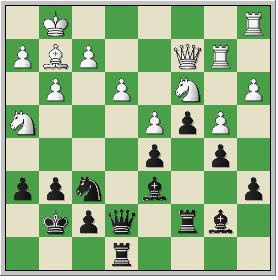

 Here I played the losing 12....Ke6, since White can play d5+ then Bf4+ and d6. What's amazing is that the best move here is 12...g6! 13.Qd5+ Kg7 14.Qxa8 Bb4+ 15.Bd2 Qe7+ 16.Kd1 and Black is ok.
 But since White did not play the best moves, the game ended up in the following postion where I could have consolidated with Qb6 and then Ke7, Kf8, but I thought I could force an exchange of queens by going Qe8, but I ended up exposing my king to a deadly attack


 Organizer : James Kanne



 All I have to do is take the knight(37 Nxd6) and then Play 38.Q f5 or 38.Q e2.

 I am up a piece AND threatening mate but with 15 seconds left (vs about 2min) settled for a draw. I didn't see that f7 was a safe square. Earlier I made a mental note not to go to g3 as it allowes a queen check on e8. For some reason I though that f7 was a bad square too.
 17....
 But here Black has the winning move
